September 8, 2008 – 5:37 am

I love copywriting here in Brighton, and I love blogging about copywriting, digital marketing and Brighton itself. At times I’ve even been slightly evangelical about the usefulness of blogging for businesses.
Is blogging worth the effort?
But I confess that I’ve had doubts. I’ve lost faith, and wondered whether blogging is a complete waste of time, if anyone is reading my posts, if anyone cares.
Luckily, before I could get disheartened, I received a flurry of positive feedback and several new clients - all as a result of my blog.
Hallelujah! - Blogging pays off
So I can personally attest to the useful of blogging as a marketing activity. It’s especially good as a way to let people get to know you. Your website may be very slick and beautifully designed, but it’s probably deeply impersonal. People buy from people, not beautiful websites. So you should use every opportunity to show your realness.
It seems that, in business, those that succeed tend to know people. Lots of people. The more people you know, the better. Networking is a key activity for most business people - but I think blogging works well alongside this personal contact.
(Picture courtesy of Minifig)
September 1, 2008 – 5:50 am

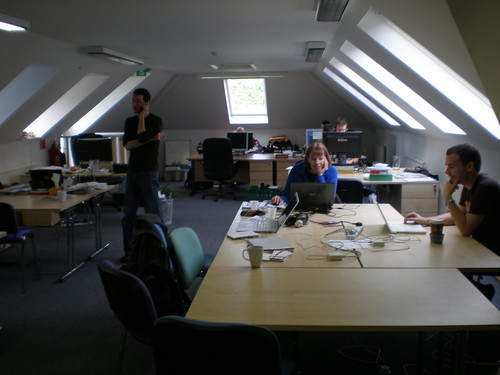
I love working in Brighton. Why?
Because I can network at The Farm or Vine Brighton, communicate with a wide web of new media professionals via the Brighton New Media email list (plus the BNM website is great for monitoring everyone’s blogs) and keep up with business matters and community affairs with Project Brighton, Sussex Digital and Wired Sussex.
But best of all is The Werks, Brighton’s best office space. Designed to meet the needs of freelancers and small businesses, The Werks combines normal office space with flexible coworking space for freelancers like me. So I can drop in and work whenever I need an office and some Wi-Fi. But the really great thing about The Werks is the friendly and helpful people who work there, and who create a space that is dynamic, innovative and nurturing.
If you work from home and ever fancy getting out and working with link-minded people, I urge you to give it a try.
On top of all that, there is the unique Brighton atmosphere: idiosyncratic, freewheeling, creative, coastal, fun-loving, passionate and bold.
(Picture courtesy of Mikelo)
August 29, 2008 – 12:13 pm

More wisdom on corporate communication from John Simmons’ We, Me, Them & It - How To Write Powerfully for Business…
On the subject of ‘fanciful’, ‘playful’, ‘imaginative’, ‘passionate’ or ‘intellectual’ language and its use in business, John suggests that we should take a few risks. Loosen up, and say what you feel. John writes:
“More and more, as I work with companies, they are yearning to be more than just an organisation focused on delivering numbers. They want to be seen as risk-taking, creative, entrepreneurial - otherwise they are too grounded in the reality of simply earning a living.”
So perhaps you should let your copywriter express your business in fresh, honest and direct language. Take a few risks, open yourselves up and let your customers know that you’re human.
Then John offers a lovely quote from John Scully of Apple:
“The new corporate contract is that we’ll offer you an opportunity to express yourself and grow, if you promise to leash yourself to our dream, at least for a while.”
Why can’t I have that written into my employment contracts?
(Picture courtesy of Broterham)
August 26, 2008 – 4:42 am

When most businesses advertise they scream out the messages they want people to absorb, while doggedly ignoring any negative news, even if that negative news is what everyone’s actually talking about.
Advertising, for most companies, is a time for rampant propaganda. Corporations create new realities based on their desired vision of a world that orbits their glorious product.
Half-baked Apples
Apple’s ad for their new telephone is refreshingly honest. When Apple released the first version of the iPhone, many people said they would wait for a 3g version. So, for many people, the 3g version was something they had been waiting for. Apple’s advertising is speaking the same language as the public. When I saw this ad, I was struck because it felt like I was listening to one of my geek friends.
Apple’s honest approach means their ad blends right in with my world. The ad’s message doesn’t jar. It just picks up the ongoing conversation. This is a very powerful persuasive technique.
Having the confidence to be honest
I’m surprised that Apple are confident enough to be so honest, because the ad admits a failing: the original iPhone was not what many people wanted. Many people viewed the first iPhone as a stop-gap - a product not worth buying. By saying that the new phone is the one everyone’s been waiting for, Apple are admitting that their initial offering was half-baked. But that’s okay, because it was.
Perhaps the marketing lesson here is that sometimes it’s better to address negative news head-on. Ignoring negatives can make them loom larger. Apple neatly twist something less-than-perfect into something that effortlessly merges with the real world.
August 22, 2008 – 5:04 am

Here’s what I mean. Below are two pieces of copy for a hammer:
Passive
This powerful hammer can strike nails into the toughest timber.
Active
This powerful hammer strikes nails into the toughest timber.
Pull back the smothering blanket
Using the active voice often shortens a piece of text. It also removes a layer of words that otherwise form a softening, smothering blanket between you and your reader. It’s important that your copy retains a sense of urgency, so use the active voice. Your copy will instantly become more direct, more powerful and more persuasive.
(Picture courtesy of Anna Banana)
August 18, 2008 – 6:05 am

“If you consciously restrict your vocabulary - and some companies do this - you end up with the linguistic equivalent of junk food…”
John Simmons - We, Me, Them & It
I’ve previously blogged about the importance of not dumbing-down corporate communications. It’s clearly a difficult balance to get right; I’m also a big fan of clear, easy to understand writing.
So how do you get it right? How do you communicate clearly with your audience but retain some depth and idiosyncrasy?
Sadly, you’ll have to decide for yourself which words will help your cause and which will baffle your reader.
But I would suggest you make sure that anywhere you need to convey information, make it clear. Be more free and playful with anything less critical. Let your corporate personality shine through when there’s less risk of ambiguity - or someone missing a key fact just because they don’t know what an unusual word means.
(Picture courtesy of Marshall Astor)

A wise copywriter once said, “People buy holes, not drills”.
The point being, of course, that when someone buys a drill it’s because they want a hole. And that’s a crucial point. Because if you try to sell someone a drill it’s essential to remember that the most interesting points to entice a buyer will be about the kind of holes that drill can make.
So if you’re a web designer, most of your clients won’t be interested in how you make their website or the technology that keeps it running – they’re just interested in having something that helps their business. People who want websites generally just want more sales, more brand awareness or a better way to communicate with their audience.
If you’re writing copy, remember to highlight the benefits of your product or service. Ask yourself, what does this product do? What can it offer to a buyer? How will it change someone’s life?
Common benefits include time-saving, money-saving and money-making. If your product can save someone time, or make someone money, you shouldn’t have much trouble selling it.
(Picture courtesy of Rae Allen)
I recently finished reading John Simmons‘ book We, Me, Them & It - How to Write Powerfully for Business, and was delighted to read this:
“Instead of saying ‘We’re committed to quality’, say ‘We check everything’. It just means a little bit more.”
Now what Simmons is espousing is honesty and directness. This kind of frank language is often frowned upon in business. Corporations think they must retain a lofty image. But who wants to do business with a distant, faceless corporation? People do business with people, so I think it makes much more sense to appeal to people with language that actually says something.
These days more and more businesses are realising the value of being human, and their copy and communications reflect this. As more people realise how refreshing it is to be addressed as a human, by a human, the more businesses will drop their formal, stuffy attitude.
But going back to the quote from John Simmons’ book- the interesting thing is that thousands of corporations say dull things like, “we’re committed to quality”, and thousands of people hear these messages and they roll over them, like another forgettable wave lapping the same tired coast. Such statements are forgettable because they’re meaningless. What does “committed to quality” mean? Committed to quality - in what way? How do you demonstrate that?
But “we check everything” tells how they’re committed to quality. It tells you: we care about what we do. We care enough to check.
(Picture courtesy of Tim Parkinson - [please note the picture hasn't got much to do with this post])

Sometimes it pays to get emotional. People are often driven by their emotions and it’s worth understanding this when marketing your business.
Can your products allay fears or reassure the anxious? Copywriters often use envy, status anxiety and guilt to play on their audiences’ emotions.
While I don’t agree with some of the manipulative methods employed by marketers, it is still essential to remember that humans are emotional animals, and much of our decision-making is affected (if not entirely led) by emotional factors.
The lighter side of emotions
Appealing to emotions doesn’t have to involve manipulating your market. You could use brighter, bolder language that makes people smile and laugh. Use honest, emotive language as a way to engage with people.
(Picture courtesy of Drs2Biz)

Donald A. Norman makes an interesting point in his book The Design of Everyday Things - that people tend to blame themselves when technology lets them down.
How often do hear people taking the blame when the printer decides to quit? Or feeling guilty because they made the computer crash? Norman suggests we should not blame ourselves - we should blame the designer.
If something goes wrong because we haven’t used it properly, the designer clearly hasn’t designed it very well. A well designed object should be intuitive to use, removing the possibility of mistakes. I think good web design follows the same principles: it shouldn’t let you make mistakes.
The picture above is only slightly relevant to this post - but it’s what made me think of Norman’s work. It shows a door that has been well-worn by thousands of hands pushing it open. The fact that the door has a push-plate made me think of The Design of Everyday Things. This doesn’t represent bad design - it’s just interesting that everyone chooses to push the door not by the push-plate.
So the next time you struggle to open a can of beans, or your computer decides to act up, blame the designer for letting you get it wrong.